
Learning to Ride a Bike
A bike with four wheels?
Back in the days when my kids were young, they each got their first "bike" with two wheels aged about 3. But in truth, it wasn't actually a bike with two wheels... it had 4! Sticking out the sides at the back were a pair of "stabilisers" or "training wheels". They come fitted to virtually all 12" wheel kids bikes, most 14" wheel a a number of 16" wheel bikes.
The typical method employed by families when they want their child to learn to ride a bike is to stick them on one of these 4 wheel bikes and wait until mum or dad thinks "time we got them stabilisers off!" or the child starts badgering at which point...
some try taking one stabiliser off first and leave one on... a surefire recipe for disaster
or
most take both off and mum or dad spends the next 3 or 4 weeks bent double running behind holding onto the sadle trying to keep up! Five minutes in, you are worn out, your back is shot and you give it up and promise to do some more with them tomorrow. With my son, I took this approach and fortunately I was lucky in that he got his balance pretty quickly so I only had a week of an hour a day chasing him up and down the road!
I've heard people suggest that the stabilisers be raised on both sides so that the wheels don't touch the ground when the bike is being sat on forcing the child to learn to balance. In reality all this does is to teach your child to ride leant over, resting on one stabiliser. Some cheap kids bikes have such badly fitted stabilisers that the bike can only ever run leant over.
The typical method employed by families when they want their child to learn to ride a bike is to stick them on one of these 4 wheel bikes and wait until mum or dad thinks "time we got them stabilisers off!" or the child starts badgering at which point...
some try taking one stabiliser off first and leave one on... a surefire recipe for disaster
or
most take both off and mum or dad spends the next 3 or 4 weeks bent double running behind holding onto the sadle trying to keep up! Five minutes in, you are worn out, your back is shot and you give it up and promise to do some more with them tomorrow. With my son, I took this approach and fortunately I was lucky in that he got his balance pretty quickly so I only had a week of an hour a day chasing him up and down the road!
I've heard people suggest that the stabilisers be raised on both sides so that the wheels don't touch the ground when the bike is being sat on forcing the child to learn to balance. In reality all this does is to teach your child to ride leant over, resting on one stabiliser. Some cheap kids bikes have such badly fitted stabilisers that the bike can only ever run leant over.
It could be so much easier...
Stabilisers most often actually prolong the time it takes to learn to ride.
Learning to ride a bike involves two (main) aspects;
- Learning to balance
- Learning to pedal
For most people, children and adults alike, the pedalling ation is not what we struggle with... it's the balance. Modern thinking (even though the history for this method dates back to the days of Dreysenne's Hobby Horse) is that we should learn to balance first. Once we know how to balance, the pedalling is considerably easier to master.
Ditch the stabilisers and remove the pedals
By taking the pedals off the bike we get rid of the need to propel the bike by pedalling. Instead, we can scoot; One leg at a time, or both legs together.
You can use this method with kids and adults.
Firstly, choose a suitable place to learn. It should ideally be a relatively large flat open area with no obstacles. Tarmac (car parks etc) are ideal but only when they are empty! Tarmac is also rather hard if you fall off so consider some protective gear particularly mitts for the hands. Knee and elbow pads are also worth considering. You can also learn on grass which is considerably softer if you fall off, but can be a little uneven for a novice.
Lower the saddle to a point where, when sat on the saddle, the feet are rested FLAT FOOTED on the ground and with the knees slighly bent.
Ask the rider to walk whilst remaining sat on the saddle. It might look a little wobbly at first but this bit is easily done.
Suggest that the rider try to keep as straight a line as possible.
Keep going back and forth down the same straight line, gradually, asking them to walk a little faster and taking longer strides each time.
This stage is a bit like the difference between running and walking. When you walk, you have always got at least one foot on the ground, but as you get faster and start to run, you will get to a point where you have neither foot on the ground. Running whilst sat on the bike leads to us "scooting".
Once we have periods where neither foot is on the ground, our balance instinct kicks in and without realising we are doing it, we make minute adjustments to our body weight to maintain our upright position: we balance. Because we haven't got to worry about pedalling, we are free to concentrate on balancing.
With a little practice, the vast majority of kids (and adults) can find their balance within an hour and many in just a few minutes.
Keep practising... introducing corners into the track.
Stopping is easiest done by dragging your feet on the ground and kids find this really easy to do so don't set them learning in their best shoes!
Once confident running along on the bike like this, suggest lifting both feet off the ground and seeing how far they can go without touching the ground.
With kids, the bike can easily be left like this, with no pedals, for quite some time.
You can use this method with kids and adults.
Firstly, choose a suitable place to learn. It should ideally be a relatively large flat open area with no obstacles. Tarmac (car parks etc) are ideal but only when they are empty! Tarmac is also rather hard if you fall off so consider some protective gear particularly mitts for the hands. Knee and elbow pads are also worth considering. You can also learn on grass which is considerably softer if you fall off, but can be a little uneven for a novice.
Do not attempt this with a bike which does not "freewheel", ie one where the pedal crank arms go round whilst ever the bike is moving. This tends to include most cheaper childrens toy bikes.
Lower the saddle to a point where, when sat on the saddle, the feet are rested FLAT FOOTED on the ground and with the knees slighly bent.
Ask the rider to walk whilst remaining sat on the saddle. It might look a little wobbly at first but this bit is easily done.
Suggest that the rider try to keep as straight a line as possible.
Keep going back and forth down the same straight line, gradually, asking them to walk a little faster and taking longer strides each time.
This stage is a bit like the difference between running and walking. When you walk, you have always got at least one foot on the ground, but as you get faster and start to run, you will get to a point where you have neither foot on the ground. Running whilst sat on the bike leads to us "scooting".
Once we have periods where neither foot is on the ground, our balance instinct kicks in and without realising we are doing it, we make minute adjustments to our body weight to maintain our upright position: we balance. Because we haven't got to worry about pedalling, we are free to concentrate on balancing.
With a little practice, the vast majority of kids (and adults) can find their balance within an hour and many in just a few minutes.
Keep practising... introducing corners into the track.
Stopping is easiest done by dragging your feet on the ground and kids find this really easy to do so don't set them learning in their best shoes!
Once confident running along on the bike like this, suggest lifting both feet off the ground and seeing how far they can go without touching the ground.
There might be some bumps and bruises along the way; all part of the learning process.
With kids, the bike can easily be left like this, with no pedals, for quite some time.
Reinstate the pedals
Once the balance has been mastered, we can add the pedals back. You will be surprised just how easy the pedalling action is once we no longer have to "think" about balancing the bike. If necessary, get them to scoot along by foot on the ground method first, then keep themselves going with the pedals.
Average learning times...
With kids, and I've seen this for myself with my 2 3/4 year old nephew (see below), as long as the bike is not too big (remember they must be able to sit on the sadlle with BOTH feet flat on the floor and legs slightly bent) then most have grasped the balance concept within an hour. Best is that during that hour, you aren't chasing them bent double trying to hold them up! Don't force it though, as the learning session has to be fun. If they get bored, pack up, go inside and tackle it another day.
Once the balance is mastered, don't rush to put the pedals on straight away!
Once the balance is mastered, don't rush to put the pedals on straight away!
Special equipment
You don't have to use anything special to learn using the pedal-less method. Just take the pedals off (or ask your local bike shop to do it). You could also remove the entire crank assembly and chain to avoid bashing ankles on the cranks.
There are some manufacturers who make bikes specifically for this purpose. Known as "learning bikes" or "running bikes", they don't have pedals at all. Originally started by a Mum and Dad from Germany, the original wooden "likeabike" has been copied the world over and now these types of bike are becoming more mainstream with some made of steel or alloy and even with suspension forks.
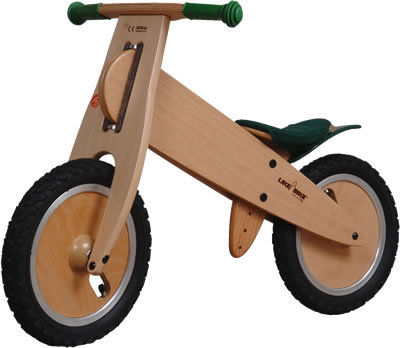
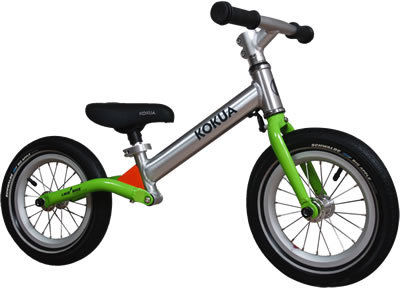
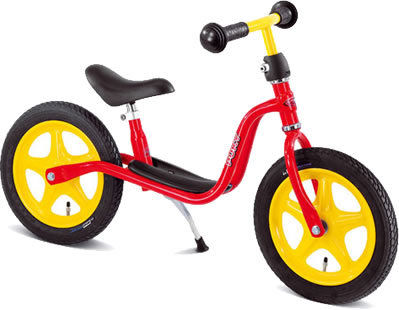
Even after they've learnt to balance, kids love to ride these types of bikes and they can be easily sold on when finished with or even kept in the loft for the next generation!
There are some manufacturers who make bikes specifically for this purpose. Known as "learning bikes" or "running bikes", they don't have pedals at all. Originally started by a Mum and Dad from Germany, the original wooden "likeabike" has been copied the world over and now these types of bike are becoming more mainstream with some made of steel or alloy and even with suspension forks.
Even after they've learnt to balance, kids love to ride these types of bikes and they can be easily sold on when finished with or even kept in the loft for the next generation!
One occassion, my sister and brother-in-law came visiting with my nephew (2 3/4 at the time of writing). They'd just got back from a week at Center Parcs and had taken his learning bike with them. He had grasped the balance concept on day 2 and had spent most of the rest of the week scooting back and forth around the site. When they visited, they again brought his learning bike and on the Sunday morning, we all went off for a visit to our local country park. They walked, he rode/scooted. More importantly, he rode/scooted round the entire lake; all 2 1/2 miles of it and all this just 1 week after his first go on the learning bike.
The comments from other people going round the lake were interesting too particularly those with four and five year olds desperately clinging to their stabilisers!
The comments from other people going round the lake were interesting too particularly those with four and five year olds desperately clinging to their stabilisers!
An update; March 2010
You know when an idea is a good one as the concept is adopted by mainstream manufacturers. Well, it's no different with learning bikes. Over the past couple of years, the choice has increased dramatically.
However, there are some which are better than others, primarily for reasons that might not spring to mind. Many come with all manner of gimmicks attached and several are extremely heavy. Look for one which is simple, lightweight and well made. Pneumatic tyres are worth the extra investment, though brakes are not strictly necessary (feet are the best brakes at this age).
Our particular favourites are the original likeabike in particular the "Jumper" [best], the Puky LR1, the Ridgeback Scoot and the Isla Bikes Rothan. Indeed, it seems mums agree as the Likeabike jumper is the highest rates learner bike over on mumsnet.
However, there are some which are better than others, primarily for reasons that might not spring to mind. Many come with all manner of gimmicks attached and several are extremely heavy. Look for one which is simple, lightweight and well made. Pneumatic tyres are worth the extra investment, though brakes are not strictly necessary (feet are the best brakes at this age).
Our particular favourites are the original likeabike in particular the "Jumper" [best], the Puky LR1, the Ridgeback Scoot and the Isla Bikes Rothan. Indeed, it seems mums agree as the Likeabike jumper is the highest rates learner bike over on mumsnet.
More guidance...
Quickrelease.tv is the blog of cycle journalist Carlton Reid. Amongst the many things he gets up to, he is a trained and approved British Cycling Go Ride coach. He has a piece on his site about learning to ride a bike too...
Image Copyrights
Images depict bikes manufactured by LikeaBike and Puky.Learning bikes are available from a number of other manufacturers and use of LikeaBike and Puky bicycle images is in no way an endorsement of their product for this purpose.
Permission for use of the images has been sought from LikeaBike UK and Puky UK and copyright over these images remains with the respective supplier.