
Safety and Security... Bicycle Locks
Lock it or lose it!
There are a multitude of types of locks available for securing your bike against a range of types of thief. But which one is best?
Here we'll discuss the various types available and try to give advice as to what they are, and are not suitable for. At the base of the page, we'll also introduce security accessories which will compliment your locks.
There are a multitude of types of locks available for securing your bike against a range of types of thief. But which one is best?
Here we'll discuss the various types available and try to give advice as to what they are, and are not suitable for. At the base of the page, we'll also introduce security accessories which will compliment your locks.
Types:
Bicycle security locks essentially take on three forms:
- Cable, Chain & Armoured Locks
- Shackle Locks
- Loop Locks (Immobilisers)
About Thefts:
The vast majority of cycle thefts are opportunist thefts. Someone sees a bike which is not secured or secured badly and take it because it's easy to do so. This is particularly common when riders "just nip into the shop" and are away for just a few minutes. The trouble is that it takes just a few seconds for the opportunist to take a bike which is not secured. Most will ride the bike away. To prevent this type of theft you should ensure that your bike is secured in such a way that it cannot be ridden away, either by immobilising it in some way, if you will only be away for that "couple of minutes", or by securing it to a fixed immovable object if your absence will be for a longer period of time.
There are a number of bikes stolen each year from within peoples own properties, either from sheds and garages or simply from the back yard. These thieves are far more accomplished in their skills and it takes a substantially different type of lock to prevent this type of thief from stealing your bike.
There are a number of bikes stolen each year from within peoples own properties, either from sheds and garages or simply from the back yard. These thieves are far more accomplished in their skills and it takes a substantially different type of lock to prevent this type of thief from stealing your bike.
Cable, Chain & Armoured Locks...
Cables...

The illustration above show the main difference between the two cable constructions.
Cable locks offer the advantage of flexibility. They are easy to wrap around other objects. Even long lengths (up to 6 feet or 1.8m) can be provided in a coiled form such that they are easy to carry on your bike. The thicker the total cable diameter, the harder it is to cut but it will also be less flexible and more heavy. For a lock which you intend to carry around, 8 or 10mm diameter should be sufficient although don't be tempted to leave your bike overnight relying solely upon a cable of this size.
Chain locks...

Chains should prove more secure than cables for longer periods but are considerably heavier. Chains can be virtually any length and because chain collapses into a pile, they can take up less space.
Armoured Locks...
are essentially a cable lock with a sequence of articulated barrels through which the cable passes. The cable is not visible. The barrels tend to rotate if a thief attempts to saw through one, because they can rotate independently of any other barrel "link".
Armoured locks are generally more secure than a standard cable lock, but are considerably heavier, comparable in weight to chain locks. They are not quite as flexible as either chain or cable locks. Lengths are also limited.
Armoured locks are generally more secure than a standard cable lock, but are considerably heavier, comparable in weight to chain locks. They are not quite as flexible as either chain or cable locks. Lengths are also limited.
Lock Mechanisms. Keys vs. Combination.
None of the above are complete without some form of locking mechanism to close the loop. Cable and Armoured locks most commonly have their mechanism attached directly to one end of the cable with a clasp pin on the other. Chain locks may have a mechanism attached but more commonly have a separate padlock of some sort.
The mechanism itself may be operated either by key or by a dial type combination. Combination mechanisms are only as secure as the combination number. If a lock does not feature a user settable combination, ensure that you remove the label that reveals that number! Key locks, in reality are less convenient than combinations because they require a certain amount of maintenance (lubrication) and people are prone to losing the keys! However, key operated locks do tend to be more secure than combination locks.
The mechanism itself may be operated either by key or by a dial type combination. Combination mechanisms are only as secure as the combination number. If a lock does not feature a user settable combination, ensure that you remove the label that reveals that number! Key locks, in reality are less convenient than combinations because they require a certain amount of maintenance (lubrication) and people are prone to losing the keys! However, key operated locks do tend to be more secure than combination locks.
Flat Keys vs. Round Keys
There is very little truth in the myth that round keys are more secure than flat keys and in the case of many cheap round key locks, the mechanism is relatively easy to force.
Shackle Locks ('D' or 'U' Locks)
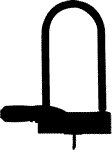
The bar should be made of hardened steel to resist cutting, as should the housing which contains the lock mechanism.
Shackle locks can be separated into 2 types: Single and Double mechanisms.
Single Mechanism shackle locks anchor one end of the U into the housing and the lock mechanism secures the other end. The key will operate the lock at one end of the housing.
Double Mechanism shackle locks have a centrally located mechanism with secures both ends of the bar independantly. The key will operate the lock from a central position (most commonly on the underside) on the housing.
Single Mechanism vs. Double Mechanism.
Better quality shackle locks are almost all of the double mechanism type and are harder to penetrate as a result. Both mechanisms would need to be broken for the bar to be released.
Pro's & Cons
A quality shackle lock is one of the most secure types of lock you can buy, however it does have its limitations.
They are solid and heavy. This makes transporting them difficult and although many come with a mounting bracket to fasten it to your bike whilst riding, these brackets are often inadequate to support the weight of the lock.
Shackle locks do not tend to be particularly large and as such you need to find something suitable to lock your bike to, eg railings. You certainly won't be able to lock your bike to a lamppost with one! Similarly, you will be unable to lock the frame and both wheels with just one shackle lock and as such you should consider supplementing your shackle lock with a loop ended cable so that you can pass the cable through the front wheel and around a wider range of fixed objects.
They are solid and heavy. This makes transporting them difficult and although many come with a mounting bracket to fasten it to your bike whilst riding, these brackets are often inadequate to support the weight of the lock.
Shackle locks do not tend to be particularly large and as such you need to find something suitable to lock your bike to, eg railings. You certainly won't be able to lock your bike to a lamppost with one! Similarly, you will be unable to lock the frame and both wheels with just one shackle lock and as such you should consider supplementing your shackle lock with a loop ended cable so that you can pass the cable through the front wheel and around a wider range of fixed objects.
Loop Locks (Immobilisers)

In its crudest form, you can simply wrap a chain or cable lock around the rim and tyre which will prevent it from passing through the frame, therefore stopping it from rotating and your bike from being ridden away. The disadvantage of this crude method is that you have to still carry the lock as a separate entity.
Genuine loop locks attach directly to your bicycle's frame and are therefore with you wherever you go. To lock the bike, you simply draw the locking bar around and through the spokes into the opposite side of the lock.
If you are only going to be away from your bike for a few minutes this is an ideal method of temporary security to prevent an opportunist theft and is actively promoted by several Police forces up and down the country. In parts of Europe where bicycle usage is far higher than it is in the UK, virtually all bikes have a loop lock.
Security Accessories
Anchor Points...
secured onto a wall or into the floor provide a fixed point to lock your bike to within a garage or shed. Bikes are commonly stolen from sheds and garages even though they have a lock on them, just not locked to anything!
Extension Cables...
with open loop ends are available to extend virtually any form of bicycle lock but are most commonly used with Shackle Locks to allow the front wheel to be locked and for the bike to be locked to larger objects.
Locking Wheel Skewers...
replace the quick release skewers fitted to many bike wheels to prevent the wheels being stolen.
Seat Leashes...
are smaller diameter short lengths of cable which can be used to prevent your saddle and seat pin being stolen if your bike is fitted with a quick release seat binder bolt.
Disc Locks...
like those used on motorbikes can be used as an immobiliser on bikes fitted with disc brakes although care should be taken to ensure that the disc lock is a suitable size for your disc. It's not an ideal solution though, as most bicycle discs are relatively thin and could be easily bent or twisted by the disc lock.
Security Marking Systems...
will not prevent your bike from being stolen, but with many owners being unable to prove that a stolen bike is actually theirs, it will improve the chances of it being returned to you if it is recovered. A thief may well find that a stolen bike which is security marked will be harder to sell on too. In some respects this means that if your bike is clearly identified as being security marked, it may reduce the chance of it being taken in favour of one which is not marked.
Electronic Tagging Devices...
will not prevent your pride and joy from being stolen, however they will make it more likely that your bike will be recovered. Again, make sure that the bike is marked as being tagged to help reduce the risk of it being taken in the first place.
Conclusions
As the majority of bicycle thefts are opportunist ones, it is essential that, no matter how long you leave your bike for, you take adequate precautions to ensure that your bike is still there when you return.
If you will only ever be leaving it for a couple of minutes at a time, then a loop lock is ideal, but for longer period you need to look for something a little more secure. Your individual needs will determine which lock, or collection of locks will best fit. It is worth taking advice from a local friendly bike shop. You may find that one lock will not be sufficient.
 There is a accreditation scheme for locks, in the form of "SOLD SECURE". Sold Secure grant 3 different levels of award according to how secure a lock is. They perform a variety of standard tests on a brand new lock, including a number of attacks with different tools and time the period taken to break into the lock. The award is granted according to how many of these set tests a lock withstands. Bronze is the lowest award and Gold is the highest. A gold award does not mean that the lock is impenetrable, just that it withstood all that Sold Secure threw at it within the allocated time! Look for a Sold Secure logo on the packaging. There is even a loop lock on the British market which is sold secure accredited at a level above many big and bulky cheap locks.
If you will only ever be leaving it for a couple of minutes at a time, then a loop lock is ideal, but for longer period you need to look for something a little more secure. Your individual needs will determine which lock, or collection of locks will best fit. It is worth taking advice from a local friendly bike shop. You may find that one lock will not be sufficient.
Tips
- Lock it up, no matter how short a period of time you intend to be away for. Even if it is visible from where you are, you should remember that a person riding a bike is faster than another running after them!
- Lock to something immovable and solid.
- Leave it in a busy, public place where there is less opportunity for a thief to work unnoticed.
- If there are other bikes parked nearby, park yours next to one with inferior security! An opportunist will always take the easy option.
- Consider a range of locks, each catering for the different locations you will need to leave your cycle.
- Spend a suitable amount of money. You do get what you pay for. Police guidelines suggest that you spend approx 10% of the value of your bike on a lock to secure it.
- Don't be fooled by cheap locks which look really beefy. Many cheap shackle locks can be broken with one blow of a brick or hammer. They may look the part, but you can guarantee that serious thieves know what they're up against.
- Some insurance policies may stipulate the use of certain kinds/brands/models of lock to qualify for insurance so if you have your bike insured, make sure that the lock you buy won't invalidate your insurance policy.